Updated October 2026.
A new fridge or washer is on the way and the old one has to go somewhere. Appliances are heavy, awkward, and in California they come with disposal rules that ordinary furniture doesn’t. Here are the options, roughly from cheapest to most convenient, and what to check before you choose.
Why appliances can’t just go to the dump
California defines “major appliances” as washers, dryers, water heaters, dehumidifiers, ovens, microwaves, stoves, refrigerators, freezers, air conditioners, trash compactors and residential furnaces. Many of them contain what the state calls materials that require special handling: refrigerants, compressor and capacitor oils, mercury switches and, in older units, PCB capacitors.
Under rules enforced by the Department of Toxic Substances Control, those materials have to be removed by a certified appliance recycler before an appliance is crushed or shredded, and refrigerant has to be recovered by a federally certified technician. So a fridge or AC unit needs to end up somewhere that can do that, not in a dumpster or on the side of the road.
Option 1: Ask the store that sells you the new one
Many appliance retailers will take the old unit away when they deliver the new one, sometimes for a fee. Ask at the time of purchase, and check the conditions: it usually has to be disconnected, emptied and ready at the delivery point.
Option 2: Your city’s bulky item pickup
Most cities in Los Angeles County run a bulky item collection through their trash hauler, and it’s often free for residents. In the City of Los Angeles, LA Sanitation’s bulky item pickup serves single-family homes (1 to 4 units); its published rules exclude commercial appliances, so call 1-800-773-2489 to confirm before putting out a household fridge. Other cities set their own limits. See our city guides for Norwalk and Cerritos as examples. The catch with any city program: the appliance has to be at the curb, and getting it there is the hard part.
Option 3: Move it yourself, carefully
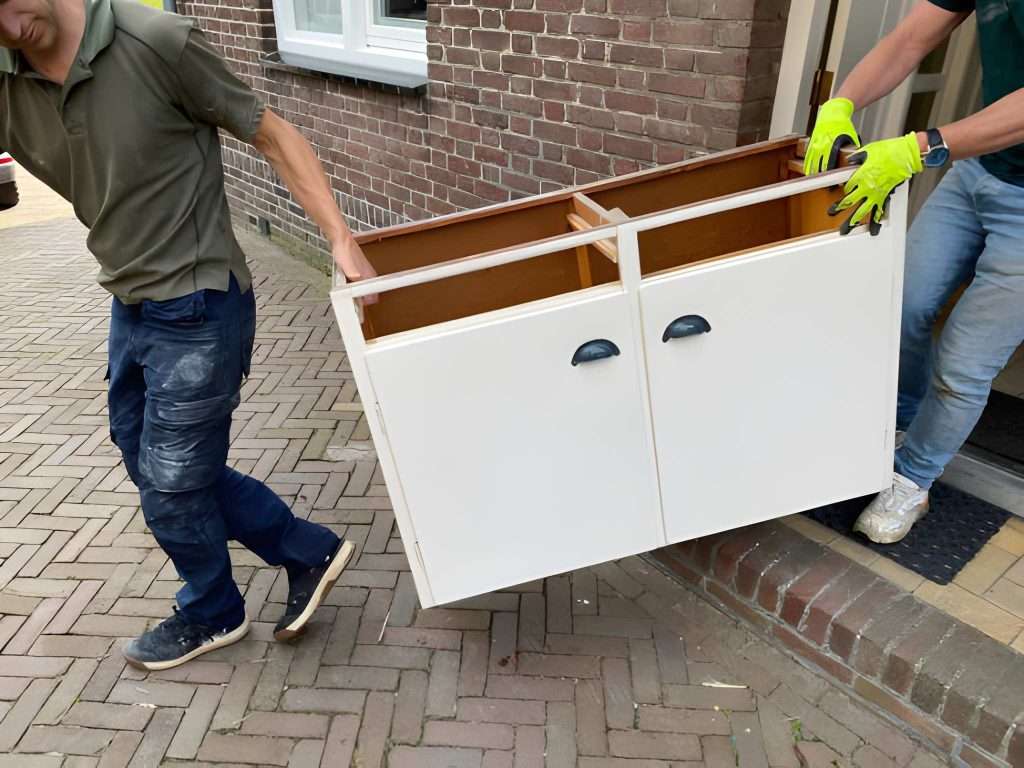
If you do it yourself, plan for the weight. A full-size refrigerator or a front-load washer is well over 150 pounds and top-heavy on stairs. Before you start:
- Empty it, and defrost a fridge or freezer a day ahead so it doesn’t leak through the house.
- Shut off and disconnect water lines. Gas appliances should be disconnected by someone qualified to do it.
- Tape doors shut and coil the cord.
- Use an appliance dolly with straps, and have a second person on the downhill side of any stairs.
- Measure doorways. Taking the fridge doors off is often what gets it out.
Option 4: Have it hauled
Paying for removal makes sense when the appliance is upstairs, in a tight kitchen or a back unit, when there’s more than one, or when you have a delivery date to hit. A&G Hauling and Junk Removal’s appliance removal crew takes it from where it sits. A single appliance is $150 and a pair, like a washer and dryer, usually fits our several-items price of $250, with labor, loading and disposal included. Tell us if anything is still plumbed, gas-fed or hardwired when you ask for a price. For fridges and freezers specifically, see refrigerator removal.
Quick answers
Can I leave an old fridge at the curb? Only as part of a scheduled bulky item pickup. Leaving one out otherwise can count as illegal dumping, and an unattended fridge with its door on is a hazard to children.
Does a broken appliance cost more to remove? No. Working or not, it’s priced the same.
Only getting rid of one thing? Our guide to getting rid of one bulky item compares every option.